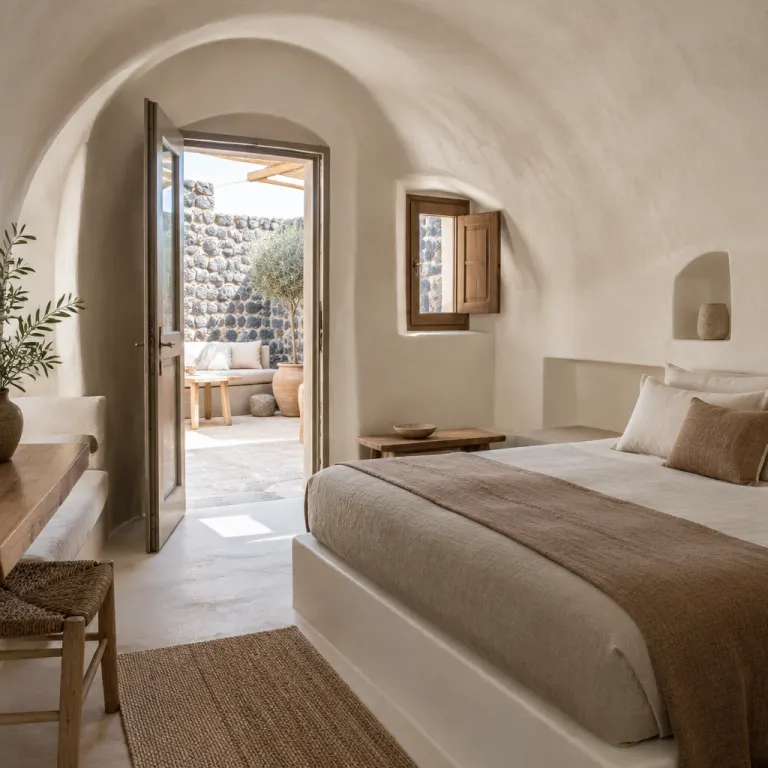
Greece Santorini houses as architectural experiences, not just hotel rooms
On Santorini island, the most memorable luxury stays begin with architecture rather than amenities. Many Greece Santorini houses are carved into the cliffs as yposkafa cave dwellings, turning every night into a quiet dialogue with volcanic stone and sea. These traditional Cycladic forms now shape some of the most refined villas and suites available through premium booking platforms across the Cyclades.
The first layer of choice is between a cave-style Santorini house and a restored captain’s mansion. Cave houses are literally carved into the rock, with walls often reaching about 1.2 meters in thickness, which creates natural insulation and a hushed atmosphere in bedrooms and bathrooms. Field measurements published in Greek architectural surveys of Santorini, such as studies by the National Technical University of Athens, confirm these substantial wall sections in historic cave dwellings. Captains and wealthy ship owners later built neoclassical villas above the cliffs, so many luxury properties today combine these raised façades with terraces that frame the caldera and wide sea views.
When browsing a luxury hotel booking website focused on the Greek islands, pay close attention to architectural details. Listings for Santorini accommodation should specify whether the house or villa is a historic yposkafa renovation or a newer construction inspired by traditional forms. Serious platforms will also indicate the number of square meters, the layout of bedrooms, and how many rooms are carved into the rock versus positioned on upper levels with a sea view. Look for clear captions and alt text on photos (for example, “Santorini cave house bedroom with caldera view”) to understand how each space relates to the landscape.
Location within the Cyclades matters as much as design. In cliffside villages like Oia, Fira, and Imerovigli, houses and villas cling to the slopes, which means many stairs but also extraordinary views over the caldera and the open sea. On flatter parts of Santorini island, you will find more horizontal homes in the local style, often with gardens, larger bedrooms, and easier access for families who prefer fewer steps between sleeping areas and bathrooms.
For travelers comparing Santorini rentals with other Cycladic islands, architecture becomes a decisive factor. Villages on the caldera rim offer the most dramatic amphitheatre-like views, while islands like Paros or Naxos provide more beach-level sea vistas from villas and holiday houses. A well curated luxury booking website should help you filter by island, interior size, number of bedrooms and bathrooms, and type of house so that the architecture matches both your aesthetic expectations and your practical needs.
From cave houses to captains’ mansions: reading the caldera from your room
Every serious luxury traveler arriving in Santorini, Greece quickly understands that the caldera is not just a backdrop. Most high-end houses are oriented, carved, and terraced around this volcanic amphitheatre, so your choice of villa or suite directly shapes how you experience the changing light. When you book, think of your room as a private viewing platform for the island’s geology.
Traditional Cycladic cave houses, or yposkafa, were created by inhabitants who carved into the soft volcanic rock using simple hand tools. These dwellings were designed to insulate against hot summers and cold winters, and their whitewashed façades reflect the sun while framing the blue sea. Many luxury villas for sale or rent today are careful restorations of these forms, where a compact Santorini house might hide two or three bedrooms behind a modest door cut into the cliff.
Higher on the cliffs, captains’ mansions in Oia and Fira tell a different story. These neoclassical villas were built by captains and wealthy ship owners who wanted raised houses with commanding views over the caldera and the wider Cyclades. When a property listing mentions a captain’s house in Santorini, expect taller ceilings, grander staircases, and more expansive terraces, often with multiple bedrooms and bathrooms opening directly to the sea view.
On a premium booking website, study the floor plans and square-meter details as carefully as the photos. A villa with 120 m² and two bedrooms carved into the rock will feel very different from a 120 m² neoclassical house with three bedrooms and two bathrooms spread across several levels. As a rule of thumb, a two-bedroom cave villa of around 80–100 m² may comfortably host four guests, while a three-bedroom captain’s house of 120–150 m² can suit six or more, depending on terrace size and privacy between suites.
If you are particularly focused on architecture, use specialized guides while you compare listings. They will help you interpret terms like traditional house, yposkafa, and captain’s villa, and explain why some cliffside homes command higher rates for the same number of bedrooms and similar interior size. In practice, a smaller but beautifully carved cave house with a perfect caldera view can feel more luxurious than a larger villa without that direct sea panorama, especially when the main bedroom and living area both open onto a single, generous terrace.
Traditional cycladic villages as open air design manuals for luxury stays
Walking through a historic settlement on Santorini is one of the most effective ways to understand local houses before you book. The lanes of Oia, Fira, and Emporio function as open-air manuals on how to place homes, villas, and bedrooms around light, wind, and sea views. When you later browse a luxury booking website, these impressions will help you read between the lines of each house description.
Traditional Cycladic architecture follows a few consistent principles that still guide the best luxury villas on Santorini island. Houses are compact, volumes are simple, and terraces are layered to maximise both privacy and the caldera or sea views. White plaster, blue accents, and rounded corners are not just aesthetic choices; they respond to the Aegean climate by reflecting heat and softening strong winds.
Many of the most sought-after Santorini houses are in villages where yposkafa cave dwellings and captains’ mansions coexist. In Oia, for example, a single lane might include a traditional home carved into the cliff, a neoclassical villa with a pedimented façade, and a minimalist renovation that merges both styles. When a listing mentions a house in a historic village, expect a dense fabric of buildings, with bedrooms and bathrooms often stacked vertically to follow the slope.
To decode how vernacular forms influence today’s luxury hotels and villas, consult in-depth architectural analyses. Reports by the Hellenic Ministry of Culture and research in the Journal of Architectural Conservation describe how terraced layouts, narrow passages, and shared stairways shape privacy and views in Santorini’s traditional neighborhoods. When you see a property or villa listing that emphasises “village integration”, it usually means the house respects these patterns rather than standing apart as an isolated object.
For travelers who value authenticity, staying in a traditional Cycladic house within a living village can be more rewarding than a remote standalone villa. You may trade a little privacy for the sound of church bells, the sight of neighbours on their terraces, and a more layered set of sea views between rooftops. On a luxury booking website, filter by village name, then compare how each house or villa uses its interior space and outdoor areas to engage with the surrounding island landscape.
Bedrooms, bathrooms, and sqm: how to read luxury listings intelligently
When you move from inspiration to actual booking, the language of square meters, bedrooms, and bathrooms becomes crucial. Santorini houses are rarely standardised, so two villas with similar floor area can feel radically different once you arrive. Reading the details with an architect’s eye will help you choose a house that matches both your comfort expectations and your aesthetic ambitions.
Start with the relationship between bedroom size and outdoor terraces. In many cave houses and cliffside villas, bedrooms and bathrooms are arranged linearly along the rock, which means some rooms may not have a direct sea view even if the property is on the caldera. A well-designed Santorini house will compensate with shared terraces, roof decks, or cleverly placed windows that still offer sea views from key spaces like the living room or main bedroom.
Next, examine how the bathrooms are integrated into the volcanic structure. In traditional layouts, bathrooms were often compact and internal, but luxury renovations now introduce skylights, carved niches, and generous showers that respect the rock while improving comfort. When a listing for Santorini accommodation highlights sculpted bathrooms or volcanic stone basins, it usually signals a thoughtful restoration rather than a generic fit-out.
Pay attention to circulation, especially in multi-level villas in Oia or Imerovigli. A beautiful property might have three bedrooms and three bathrooms spread across several terraces, but if the stairs between them are steep, it may not suit guests with reduced mobility or families with young children. Quality booking websites will often specify the number of steps from the street to the entrance, and from the entrance to the main bedrooms; in cliffside villages, this can easily range from 30 to more than 150 steps, which is essential information on such a vertical island.
Finally, consider how the total floor area interacts with the caldera or sea view. A compact 60 m² villa with a wide terrace and uninterrupted sea views can feel more luxurious than a 120 m² house without outdoor space. Platforms that specialise in the Cyclades tend to highlight these spatial qualities rather than just listing raw square meters and the number of bedrooms and bathrooms, often using simple diagrams or sample floor plans to show how indoor and outdoor areas connect.
Luxury, authenticity, and the question of sale versus stay
For some travelers, a short stay in a Santorini house is only the beginning. The emotional impact of waking up to the caldera, walking through a traditional village, and inhabiting a carved dwelling often leads to curiosity about property opportunities. Luxury villas and houses on Santorini island sit at the intersection of hospitality and real estate, and understanding this context can enrich your booking decisions.
Listings that mention villas for sale or investment properties are usually targeted at buyers, but they also reveal how the market values certain architectural features. A house with direct sea views, generous terraces, and carefully restored bedrooms and bathrooms will command a premium both for nightly rates and for long-term sale prices. Local real estate agencies consistently highlight caldera frontage, private outdoor space, and heritage renovation quality as the main drivers of value in Santorini’s high-end market.
In Oia and Fira, captains’ mansions and large villas with multiple bedrooms are particularly sought after. These houses combine neoclassical façades with deep volcanic basements, allowing for several self-contained suites within a single complex. For guests, this translates into more privacy between bedrooms and bathrooms, and for owners, it creates flexible layouts that can shift between private use and luxury rental.
Cave houses carved into the cliffs remain the soul of Santorini architecture, and they are often the first choice for travelers seeking authenticity. Many of these homes have been renovated by local teams who specialise in working with volcanic stone, preserving original curves while upgrading insulation and mechanical systems. When a listing emphasises “heritage renovation” or “traditional house restoration”, it usually signals a long-duration project rather than a quick cosmetic update.
Whether you are booking a short stay or quietly evaluating future purchase options, treat each listing as a case study in how architecture, landscape, and hospitality intersect. The most compelling luxury villas on Santorini island are those where the caldera, the sea, and the traditional Cycladic forms are in balance. By reading the details on floor area, bedroom and bathroom layouts, and the relationship between indoor and outdoor spaces, you will quickly distinguish between houses designed for quick turnover and houses shaped for enduring, beautiful living.
Practical guidance for choosing the right Santorini village and house type
Choosing where to stay among Santorini houses is as much about village character as it is about the villa itself. Each settlement on the island offers a distinct balance of views, privacy, and access, and a good luxury booking website will help you navigate these nuances. Before you confirm a house or villa, match the village profile to your travel style.
Oia is the emblematic postcard setting, with houses and villas cascading down the northern rim of the caldera. Here, many luxury properties are compact, with bedrooms and bathrooms stacked vertically and terraces oriented toward sunset views. If your priority is a dramatic caldera panorama and you do not mind stairs, a traditional house in Oia or nearby Finikia will feel intensely atmospheric.
Fira and Firostefani sit closer to the island’s transport hub, which makes them practical bases for exploring the wider Cyclades. In these villages, accommodation ranges from small cave dwellings to larger villas with several bedrooms and shared pools. Travelers who want both sea views and easy access to restaurants, shops, and ferries often choose a villa or house here, trading a little tranquility for convenience.
On the opposite side of Santorini island, villages like Kamari, Perissa, and Perivolos open directly onto long black-sand beaches. Houses and villas in these areas usually offer more horizontal layouts, with bedrooms and bathrooms on a single level and gardens or courtyards instead of cliffside terraces. If you prefer to step from your house to the sea without navigating steep paths, these beachside villages are ideal.
For a quieter, more traditional Cycladic atmosphere, consider Pyrgos, Emporio, or Megalochori. Here, houses cluster around squares and narrow lanes, with fewer direct caldera views but a strong sense of village life. A traditional home or villa in these settlements often offers generous bedrooms, thick stone walls, and intimate courtyards, making them excellent choices for longer stays or for travelers who value cultural immersion over iconic vistas.
Expert insight and heritage context for architecture focused travelers
Understanding the heritage behind Santorini houses adds depth to every stay. The island’s architecture evolved from necessity, shaped by volcanic terrain, scarce timber, and the need for insulation against both heat and cold. What now reads as luxury in many villas and houses began as pragmatic responses to a demanding landscape.
Yposkafa cave houses were the earliest forms, carved directly into the soft volcanic rock by inhabitants using simple hand tools. These dwellings offered natural climate control and protection from strong winds, which is why many of today’s most exclusive villas still rely on similar carved volumes for bedrooms and bathrooms. Later, captains and wealthy ship owners built neoclassical mansions above the cliffs, introducing higher ceilings, symmetrical façades, and more formal layouts that now define many luxury villas in Oia and Fira.
Renovation practices on Santorini island have become increasingly sophisticated, especially for high-end hospitality projects. Architects and engineers work with wall thicknesses that can exceed 1.2 meters, integrating modern mechanical systems without compromising the integrity of the rock. Studies of Cycladic vernacular architecture, including research cited by the Hellenic Ministry of Culture and articles in the Journal of Architectural Conservation, document how these construction methods evolved to balance stability, insulation, and seismic performance.
For travelers booking through a premium Cyclades platform, this heritage context translates into more informed choices. When you see a listing for a traditional house that emphasises original arches, lime plaster, and volcanic stone floors, you can expect a more historically grounded experience. In contrast, some newer villas for sale may prioritise expansive glazing and contemporary lines, which can still be beautiful but relate differently to the caldera and the wider island landscape.
Ultimately, the most rewarding Santorini houses are those where heritage, comfort, and setting align. Whether you choose a compact cave home with two bedrooms and a single terrace, or a sprawling villa with multiple bathrooms and layered sea views, the key is to read the architectural story behind the listing. Doing so will help you select not just a place to sleep, but a house that frames Santorini in a way that resonates with how you want to experience this Greek island icon.
Key figures and architectural statistics for Santorini stays
- Typical wall thickness in traditional yposkafa houses reaches about 1.2 meters, according to field measurements cited in Greek architectural surveys of Santorini and studies referenced by the National Technical University of Athens, which explains their exceptional natural insulation and quiet interiors.
- A significant share of luxury villas and houses on Santorini island are carved partially into volcanic rock, a method that reduces the need for timber in construction and responds to the island’s historic resource constraints; local planning documents and conservation reports consistently note this hybrid carved-and-built typology.
- Historic development followed a clear sequence, with cave houses established first and neoclassical captains’ mansions added mainly in the 18th and 19th centuries, creating the layered architectural fabric seen in Oia and Fira today, as outlined in heritage studies by the Hellenic Ministry of Culture.
- Many renovated Santorini houses now combine traditional Cycladic exteriors with minimalist interiors, a design approach that maintains vernacular forms while meeting contemporary expectations for generous bedrooms, spa-style bathrooms, and integrated wellness facilities such as plunge pools and steam showers.
FAQ about Greece Santorini houses and luxury stays
What makes greece santorini houses different from other Cycladic island accommodations ?
Greece Santorini houses are often carved into volcanic cliffs, creating yposkafa cave interiors with thick walls and naturally cool bedrooms and bathrooms. This contrasts with many other Cyclades islands, where houses and villas are more commonly freestanding stone structures on flatter terrain. The combination of carved spaces, terraced layouts, and direct caldera views gives Santorini architecture its distinctive character.
Are cave houses comfortable for luxury stays with modern amenities ?
Well renovated cave houses on Santorini island can be extremely comfortable, as long as the restoration has integrated modern systems carefully. Many luxury villas now include underfloor heating, advanced ventilation, and high quality bathrooms carved into the rock without losing the traditional house atmosphere. When booking, look for listings that specify recent renovations and clearly describe the bedroom and bathroom layout and available amenities.
How many stairs should I expect in villages like Oia Santorini ?
Cliffside villages such as Oia and Fira are inherently vertical, so most Greece Santorini houses there involve multiple staircases. You may encounter dozens of steps between the street and your house, and additional stairs between terraces, bedrooms, and bathrooms inside the villa. Travelers with mobility concerns should prioritise listings that mention easier access or choose houses in flatter areas of Santorini island or other Cycladic islands.
Is it better to stay in a traditional house or a modern villa ?
The choice between a traditional house and a modern villa on Santorini island depends on your priorities. Traditional Cycladic houses and cave villas offer stronger connections to local heritage, with carved rooms, thick walls, and intimate terraces overlooking the sea. Modern villas may provide larger bedrooms, expansive glazing, and more open-plan living, which some guests prefer for longer stays or group travel.
Can I use hotel booking websites to research potential property sale opportunities ?
Luxury hotel booking websites focused on Greece Santorini houses can be useful for understanding market expectations before exploring property sale options. By comparing nightly rates, locations, and architectural details of villas and houses, you gain insight into which features command higher value. However, any serious interest in villas for sale or long-term investment should be followed by consultation with local real estate professionals and legal advisers.